Electric Motor Controls, VFD Solutions & Power Quality Experts Since 1953
Legacy 7 Decades of Power‑Systems

Roger T. Fritz: Power & Control Expert
Roger T. Fritz — Managing Seven Decades of Power‑Engineering Solutions
⚡
The Second Generation — Global Industrial Engineering
Born in O’Neill, Nebraska, Roger T. Fritz grew up inside motors, controls, and manufacturing. Engineering wasn’t a career — it was the family language.
Roger’s technical foundation was shaped by:
- Curtis Read, legendary RCA engineer
- Redal Curtis, IEEE and power‑plant switching expert
These mentors built Roger’s mastery of:
- electrical power quality
- VFD technology
- motor‑system efficiency
- industrial energy conservation
- harmonics and IEEE 519 compliance
- advanced control systems
⚡ THE GLOBAL FIELD ENGINEER — “THE MAN WHO GOT IT DONE”
Roger’s career took him into the toughest plants in the world:
- power plants
- plastics plants
- hockey rinks
- schools
- hospitals
- municipal systems
- heavy industrial operations
From Boston to California to Puerto Rico, Roger walked into plants alone — with meters, knowledge, and grit — and got it done.
He didn’t sell theory. He proved results.
He saved companies thousands in electrical power, corrected failing systems, and delivered solutions no boardroom puppet could replicate.
⚡ PLASTICS INDUSTRY — EPRI RECOGNITION
During the 1990s EPRI Power Quality and Tailored Collaboration programs, Roger was recognized as the go‑to specialist in plastics‑industry energy reduction and VFD applications.
EPRI developed full technical reports around Roger’s:
- diagnostic methods
- VFD applications
- injection‑molding energy savings
- power‑quality corrections
This placed Roger at the center of national research.
⚡ THE FIRST VFDs WHERE THEY SAID IT COULDN’T BE DONE
Roger became known for doing what others refused to attempt:
He installed the first VFDs in applications where OEMs, consultants, and engineers insisted it could not be done.
These installations became case studies for utilities and manufacturers nationwide.
He performed for top companies including:
- Sterilite Plastics
- First Plastics
- BNZ Materials
- GDF Suez (ENGIE)
- Thousands of industrial plants across the U.S. and internationally
⚡ CALIFORNIA EXPANSION — BLEVINS & FULLER ELECTRIC (1984)
In 1984, Roger expanded the Fritz legacy into California by purchasing Blevins Electric and Fuller Electric in Chico.
For eight years, Roger personally trained the owners and technicians who would later run these companies, teaching them:
- advanced motor diagnostics
- VFD applications
- power‑quality correction
- the old‑guard repair culture
Today, those companies continue under leadership trained directly by Roger.
⚡ UTILITY PARTNERSHIPS — PG&E & SOUTHERN CALIFORNIA EDISON
Roger served as a primary application expert for PG&E and Southern California Edison, guiding early adoption of:
- VFDs
- high‑efficiency motors
- harmonic‑compliant systems
- industrial load reduction
- motor‑system optimization
He trained engineers, contractors, and industrial customers long before VFDs became mainstream.
⚡ INDUSTRY TESTIMONIALS — GDF SUEZ & BNZ MATERIALS
Global operators issued direct testimonials:
- GDF Suez (ENGIE) — validating Roger’s power‑plant optimization work
- BNZ Materials — confirming his VFD applications and energy‑savings results
These testimonials are evidence, not marketing.
⚡ PEPSICO & NATIONAL GRID — TOP ENERGY RESULTS
Roger’s results were so extraordinary that:
- PepsiCo
- National Grid
formally recognized him for delivering the most impressive energy‑savings results ever recorded in their programs.
⚡ MASS SAVE 2012 — RECORD‑SETTING IMPACT
In 2012, Massachusetts achieved $5.5 billion in statewide benefits and earned the #1 national ranking for energy efficiency.
Roger’s company delivered one of the largest verified portions of Commercial & Industrial energy‑efficiency results in the entire Mass Save program — a dominant share of the completed savings.
His motor‑system and VFD projects were a major part of the industrial performance that made the record year possible.
⚡ GLOBAL INDUSTRY NETWORKS & PROFESSIONAL INFLUENCE
⚡ 30,000+ First‑Tier Electrical Solution Providers
Roger maintains direct industry partnerships with over 30,000 first‑tier electrical solution providers on LinkedIn — one of the largest independent engineering networks in the world.
⚡ 101 Professional Groups — Over 9 Million Members
Roger participates in 101 professional engineering groups, representing over 9 million members across electrical engineering, automation, utilities, and industrial technology.
⚡ 72 Company Product‑Solutions Pages
Roger manages 72 company product‑solutions pages on LinkedIn — a massive technical library covering motors, VFDs, soft starters, control panels, power‑quality solutions, and industrial diagnostics.
⚡ Head of the Nikola Tesla Group — 8,000+ Members
Roger leads the Nikola Tesla Group, a global engineering community of over 8,000 elite members dedicated to advanced motor‑system design, power‑quality innovation, and real‑world industrial excellence.
⚡ Free Monthly Engineering Classes
Roger provides free monthly classes on subjects most experts avoid:
- proper metering
- harmonics
- phase conversion
- motor diagnostics
- advanced VFD applications
Thousands attend these classes across his global networks.
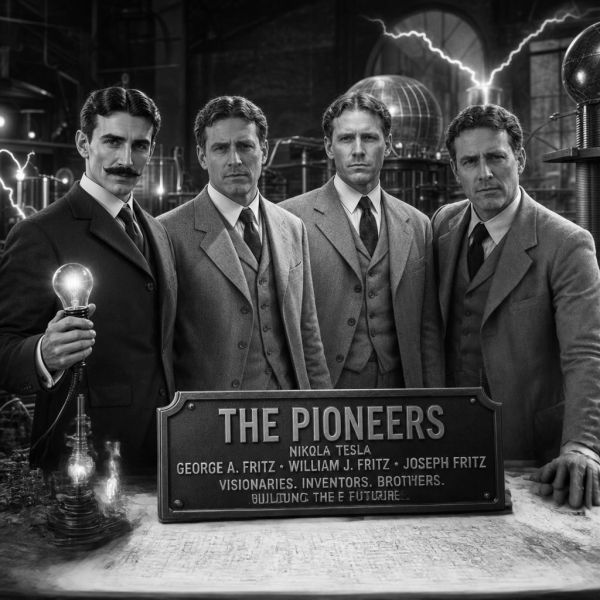
Seven decades
The Men Who Built a Legacy of Electric Motor Control & Systems Excellence
The Fritz legacy began in O’Neill, Nebraska, where three brothers — George A. Fritz, Joseph Fritz, and William J. Fritz — returned from military service after World War II and built something extraordinary. With nothing but discipline, skill, and determination, they founded Northwest Electric Motor Service in 1953, a company that would become the backbone of motor‑repair culture across the Midwest.
They were not ordinary electricians. They were problem‑solvers, innovators, and builders.
William J. Fritz — the eldest — became the technical visionary. His work with MIT and NASA on atmospheric electrical research, including a 300‑foot test tower and a 36‑mile conductor loop delivered by train, set engineering standards still respected today.
George and Joseph expanded the legacy into 13 companies, mastering motors, controls, manufacturing, diagnostics, and agricultural machinery. Together, they created a repair culture built on honesty, precision, and American craftsmanship — a culture that shaped the next generation.
Their work wasn’t just business. It was family, duty, and engineering excellence.
This is the foundation that shaped Roger T. Fritz — and the legacy that continues today.

William J. Fritz: Power Innovator
William J. Fritz was an engineer, inventor, and visionary whose work in electrical power, manufacturing, and applied research placed him decades ahead of his era. Born with a natural instinct for machinery and problem‑solving, William’s life took shape through service, discipline, and an unrelenting drive to understand how power moves the world.
After serving in the U.S. military during the rebuilding of Germany following World War II, William developed a mastery of electrical systems under extreme, real‑world conditions. His technical skill and leadership quickly drew national attention, leading to a historic commission from MIT to lead one of the most ambitious electrical research projects of its time.
At the center of this project stood a 300‑foot experimental tower, surrounded by a 36‑mile semi‑circle of electrical conductor delivered by train and installed with military precision. Working in partnership with NASA and leading scientific institutions, William oversaw atmospheric and electrical experiments involving controlled gas releases, aircraft‑based data collection, and early computer‑driven frequency‑control systems housed in a full semi‑trailer mobile lab. The test site in O’Neill, Nebraska—chosen for its vast, flat terrain—became a proving ground for breakthroughs in airflow, induced power, and atmospheric behavior.
This project marked the beginning of a legacy.
William’s passion for innovation inspired his brothers—Joe, Donald, and George, all military‑trained electricians—to join him in building what became one of the most diverse and inventive family enterprises in the Midwest. Together, they founded 13 companies, each rooted in practical engineering and American manufacturing:
- Industrial fan manufacturing
- Steel pipe fabrication
- Agricultural equipment and machinery
- Multiple patented technologies
- Tractors and power systems
- Electric motors, controls, and phase converters
- And a wide range of industrial and agricultural innovations
Their companies powered farms, factories, and communities across the region, creating jobs, solving real‑world problems, and setting new standards for reliability and craftsmanship.
William J. Fritz was more than an engineer — he was a builder of opportunity. His work blended scientific curiosity with hands‑on practicality, and his influence shaped the next generations of the Fritz family, including the continuation of the electrical and motor‑systems legacy through AC‑DC Hotline and beyond.
His life stands as a testament to American ingenuity: service, innovation, and the courage to build what has never been built before.
About AC DC Hotline

Our Heritage
Our Heritage
Our Heritage
Founded in 1953, AC DC Hotline combines decades of electrical expertise with a global supply chain. We provide hands-on support for motor controls, VFDs, soft starters, and more. Led by Director Roger Fritz, our team ensures reliable, practical solutions for industry needs.
Our Services
Our Heritage
Our Heritage
We serve industry with top-tier motor controls, VFDs, sensors, and power solutions. Our global network guarantees quick delivery and expert support to keep your operations running smoothly.
Our Method
Our Heritage
Our Method
Our technical expertise and customer focus ensure fast, accurate support. We diagnose issues, recommend solutions, and deliver reliability with proven field experience.